How to Choose the Best Marketing Agency in Punta Cana
A practical guide to choosing the right marketing agency in Punta Cana. What to ask, what to avoid, and how to find the best partner for your business.
Punta Cana has a problem that few people talk about openly: there are more marketing agencies than ever, and figuring out which one is actually worth your money — versus which one will leave you with a nice Instagram feed and zero results — is getting harder every year.
Search "marketing agency in Punta Cana" on Google and you'll find polished websites, glowing testimonials, and promises of tripling your sales in 90 days. The problem is that some of those promises come from agencies that have been operating for six months, outsource everything to freelancers abroad, and have never worked with a real business in Bavaro, Cap Cana, or along Boulevard Turístico del Este.
This guide is not a directory of agencies. It's an honest framework to help you ask the right questions, spot red flags, and find the partner who genuinely understands the Punta Cana market and what your business actually needs to grow.
The Punta Cana digital market is growing — and the choice matters more than ever
Punta Cana is not just beaches and resorts. It's one of the fastest-growing commercial markets in the Caribbean and the Dominican Republic. Real estate development in Cap Cana and Bavaro keeps expanding. Independent restaurants, wellness centers, boutique tour operators, and professional services businesses now compete for an audience that is more sophisticated and more demanding than it was five years ago.
That audience — high-income tourists, international real estate buyers, expats living in the area, upper-middle-class Dominicans — researches on Google before booking, before buying, before trusting. The first thing they see is your digital brand. And if your digital brand doesn't communicate professionalism, credibility, and clarity, they're looking at your competitor five seconds later.
This is where a marketing agency comes in. The job of a good agency is to build and manage that digital presence so it works for you while you run your business. But the job of a bad agency — or simply one that doesn't understand your market — can cost you time, money, and real opportunities.
The question isn't whether you need an agency. The question is how to find the right one.
That's why, before talking about pricing, packages, or contracts, you need to understand what types of agencies exist in the Punta Cana market and what each one offers.
What types of agencies exist in Punta Cana
The digital marketing ecosystem in Punta Cana is more varied than it appears. Understanding the categories helps you choose based on your situation, your budget, and your goals.
Full-service local agencies
These are agencies with a physical office (or at least a team based in) Punta Cana or the Dominican Republic, offering a full range of services: strategy, branding, web design, social media, paid advertising, SEO, and content. The main advantage is local market knowledge — they understand tourism seasonality, real estate market cycles, Dominican consumer behavior, and the dynamics of the international client who visits or invests in the area. Their disadvantage can be price — they're generally more expensive than other options — and quality varies significantly from one to another.
Independent freelancers
Designers, community managers, Google Ads specialists, or photographers who work on a project or retainer basis. They're the most affordable option and can be excellent for specific tasks. The problem appears when you try to build a coherent strategy across three different freelancers: the designer doesn't talk to the copywriter, the community manager posts whatever they can, and nobody has the full picture of your brand. For businesses that are just starting out or for one-off projects, they can be ideal. For an integrated marketing strategy, they don't scale well.
Remote agencies (national or international)
Agencies based in Santo Domingo, Mexico City, Buenos Aires, or Miami that work remotely with clients in Punta Cana. Many have more mature processes, more specialized teams, and competitive rates. The risk is that they don't know the local market: they can design perfect campaigns for a different context that simply don't work in Bavaro. If you're evaluating a remote agency, make sure they've worked with tourism or real estate businesses in comparable destinations.
Local niche specialists
Some individuals or small teams specialize in a specific sector — boutique hotels, restaurants, real estate — and know that niche in depth. They can be highly effective if your business falls within their area of expertise. They're not for everyone, but when there's a real match, the work tends to be very precise.
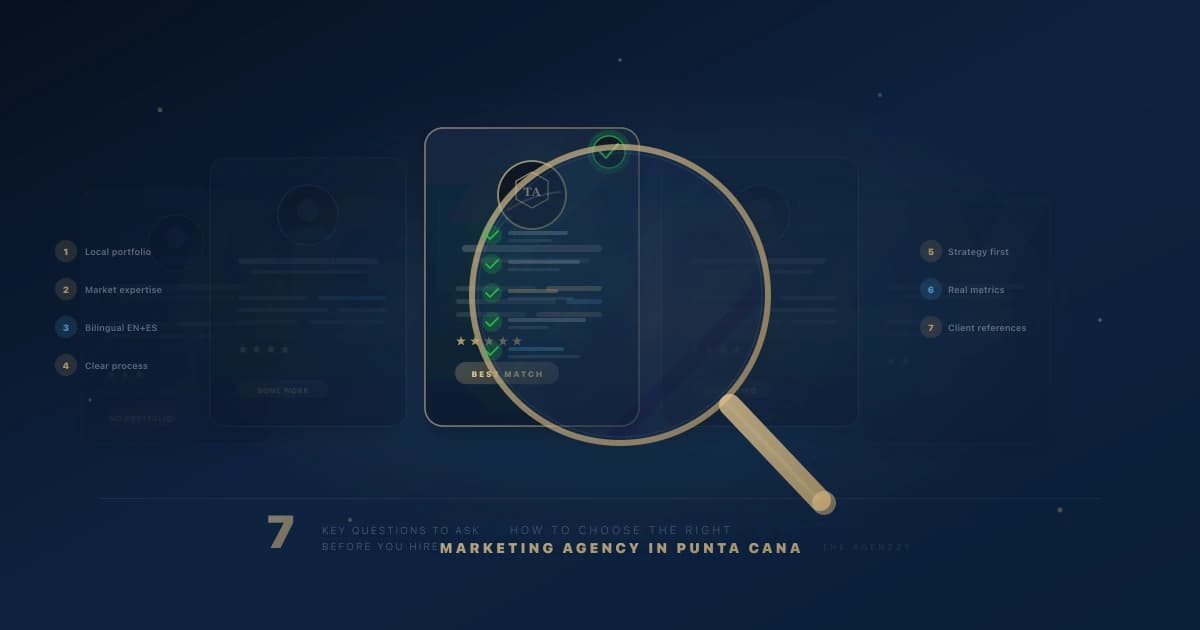
The 7 questions you must ask before hiring an agency
Before signing any contract or paying any deposit, these are the questions you should ask in your first meeting with any marketing agency in Punta Cana. The answers — and the way they give them — will tell you more than any commercial proposal.
1. Do they have a real portfolio with local clients?
Not mockups. Not conceptual projects. Not "we've worked with similar brands in other countries." Ask for links to live websites, active Instagram accounts, and advertising campaigns you can trace. Ask specifically whether they've worked with businesses in Punta Cana, Bavaro, Cap Cana, or the Eastern region.
An honest portfolio has completed projects, live and running, with verifiable results. If all they have are renders and screenshots without context, that's a signal.
2. Do they understand the Punta Cana tourism and real estate market?
The Punta Cana market has very specific characteristics that a generic agency can easily miss:
- Dual seasonality: high season from December through April (American and European market) and a summer uptick (Latin American and Dominican market). Content and advertising strategies need to adjust to these cycles.
- Bilingual market: your clients may arrive in English, in Spanish, or both. It's not just about translation — it's about understanding how each audience communicates.
- Long decision cycles in real estate: a Cap Cana condo buyer can take 6 to 18 months to close. The nurturing and content strategy is completely different from a restaurant where a decision is made in minutes.
- Reputation on specific platforms: for hospitality, Google Business, TripAdvisor, and Airbnb matter as much as Instagram.
If the agency you're evaluating can't speak with depth about these dynamics, they're learning on your budget.
3. Can they work bilingually (Spanish and English)?
This goes beyond having someone who "sort of speaks English." For businesses in Punta Cana serving international markets, native bilingual communication is non-negotiable. Ask who writes the copy in English and who writes it in Spanish. Are they native in both languages? Or do they translate from one to the other?
Well-crafted English copy written for American tourists doesn't sound the same as copy translated from Spanish. There are differences in tone, cultural references, and expectations. For premium hospitality, real estate, or professional services, that nuance is worth real money.
4. What is their process and what are the realistic timelines?
A serious agency has a documented process. They don't start designing on day one — they start with a discovery phase, then strategy, then execution. Ask how they structure projects, how long each phase takes, how they handle revisions and feedback, and what happens when there are delays.
If the answer is vague or improvised ("we do whatever the client needs"), that's a sign the process doesn't exist — and without a process, projects stretch, results dilute, and communication becomes chaotic.
Also ask for realistic timelines, not optimistic ones. An agency that promises a website in two weeks when you don't have photography or content ready is setting expectations that will frustrate both of you.
5. Do they offer strategy or just execution?
There's an enormous difference between an agency that executes what you tell them and one that thinks alongside you about how to grow your business. The former is useful if you already know exactly what you need. The latter are growth partners.
Ask directly: "How do you decide what content to publish?" If the answer is "whatever you tell us" without further depth, you're hiring executors. If the answer includes audience analysis, competitive research, metrics review, and iterative adjustment, you're talking to strategists.
For businesses that genuinely want to grow in Punta Cana, you need strategists.
6. What metrics do they track and how do they report results?
Any agency can publish content. The question is: what happens next? How do they measure whether what they're doing is working? How often do they send reports? What metrics do they prioritize?
The metrics that matter depend on the business:
- For a restaurant in Bavaro: reservations, calls, website visits from Google Maps, new reviews
- For a real estate firm in Cap Cana: qualified leads, cost per lead, conversion rate from inquiry to showing
- For a boutique hotel: occupancy attributable to digital channels, direct traffic versus OTAs
An agency that only talks to you about "reach," "impressions," and "likes" without connecting those numbers to business results isn't managing your marketing — they're managing your Instagram account.
7. Can you talk to past clients?
Ask for references. Specifically, ask to speak with clients who hired the same type of service you're considering — not the agency's star portfolio client, but an average one. A trustworthy agency facilitates these conversations without hesitation.
When you speak with referenced clients, ask: was the process organized? Did results arrive within the promised timelines? How was communication when something went wrong? Would they hire them again?
Red flags: how to identify a problematic agency
The Punta Cana market, like any growing market, has its share of agencies that sell more than they deliver. These are the most common warning signs.
Promises of immediate results
"We'll triple your sales in 30 days." "Guaranteed first-page Google ranking in three weeks." "100 leads per month or your money back."
Honest digital marketing doesn't work that way. SEO takes months to produce results. Advertising campaigns need optimization time. Building a brand that converts requires consistency, not magic. If an agency promises specific results in unrealistically short timeframes, they're selling you what you want to hear — not what's going to happen.
No verifiable portfolio
If the work examples they show you are Behance mockups, sites that "are no longer active," or projects without a real client name, there's a problem. A real portfolio has work in production that you can visit, verify, and evaluate in real time.
Generic templates for everything
Some agencies have a standard package they apply to all their clients: same type of posts, same publishing calendar, same website structure with changed text. If in your first meeting they're already showing you an "Instagram package" with 12 monthly posts without having asked you anything about your business, your audience, or your goals, you're looking at a mass-production agency — not a strategic partner.
No clear contract or a confusing one
There should always be a contract that specifies: what services are delivered, on what timeline, what is included and what is not, how payments are handled, and how the relationship ends if things don't work out. An agency that asks you to trust their word, or presents an ambiguous one-page contract, is leaving gaps open that will be used against you when something goes wrong.
Vanity metric reports
If the monthly report you receive is full of "we reached 50,000 people this week" and "Tuesday's post got 800 likes," but there's not a single line about how many people visited your website, how many calls you received, or how many leads the campaign generated, you're not receiving a report — you're receiving marketing designed to stop you from canceling the contract.
No access to your own accounts
Your Google Business listing, your Facebook page, your Instagram profile, your web domain — all of that belongs to you. Any serious agency works from your own accounts or, if they create new ones, gives you admin access from day one. If an agency tells you "we handle everything, you don't need access," leave that meeting.
Green flags: what a good agency looks like
Just as important as identifying the bad is recognizing the good. These are the signs of a marketing agency in Punta Cana that deserves your serious consideration.
Transparent pricing from the start
You don't have to guess what it's going to cost. A professional agency has clear rates or at least a defined range for their main services. If asking about price gets you "it really depends on what you need" with no ballpark figure, that's not flexibility — it's a lack of structure.
You can read more about what to expect in terms of budget in our guide on the cost of hiring a marketing agency in the Dominican Republic.
A documented and clear process
They can explain, step by step, how they work: what happens in the first weeks, how creative decisions are made, how changes are handled, how success is measured. This level of operational clarity doesn't appear overnight — it's the result of working with many clients and learning from mistakes.
Genuine local knowledge
They can speak in detail about the Punta Cana market: the seasonal cycles, the difference between the Bavaro and Cap Cana markets, how the American tourist behaves versus the European versus the local Dominican. Not in generic terms — with concrete examples, real cases, and nuances that only come from actual experience working in this territory.
A modern tech stack
They use current tools: Google Analytics 4, Meta Ads Manager, email automation platforms, CRM for lead tracking, SEO tools like Ahrefs or Semrush. They can show you the tools they use and explain what each one does. An agency that "works with Excel and WhatsApp" to manage campaigns doesn't have the sophistication your business needs.
Honesty about what they can't do
The best agencies don't pretend to be experts in everything. If they don't have experience in TikTok advertising, they say so. If your niche is outside their area of expertise, they let you know. That honesty is a sign of professional maturity and respect for your budget.
Local vs. international agencies: pros and cons for Punta Cana businesses
This is a decision many business owners in Punta Cana face, especially those with primarily international markets.
Local agencies (Dominican Republic)
Advantages:
- Direct knowledge of the local market, culture, and Dominican consumer dynamics
- Ability to meet in person, run photography and video shoots locally
- Understanding of the platforms and channels that dominate the local market
- Communication in a compatible time zone
- Local network of contacts (photographers, influencers, media)
Disadvantages:
- Some local agencies have less mature processes than their international equivalents
- The pool of specialized talent (in performance marketing, technical SEO, for example) is more limited
- Well-documented success cases in international markets are less common
International agencies
Advantages:
- More mature processes and more specialized teams
- Experience with international markets similar to Punta Cana (tourism, real estate, hospitality)
- Access to high-level talent in specific niches
- Proven success cases in larger-scale campaigns
Disadvantages:
- They don't know the local market and may not understand Punta Cana's specific dynamics
- The language barrier can surface (quality Spanish copy for the Dominican market is hard to outsource)
- Time zone differences can affect communication and response times
- The cost is typically significantly higher
The practical recommendation: For most businesses in Punta Cana, a local or regional agency with demonstrated experience in tourism and international markets is the best option. If your business has a very specific international acquisition component — for example, a real estate firm selling exclusively to American buyers — it can make sense to complement with an international specialist in that segment.
It's also worth reading our article on why your Punta Cana business needs a professional creative agency to understand what to expect from full-service agency work.
Budget allocation: how to distribute your marketing budget wisely
One of the most common questions we receive is: "How much should I spend on marketing?" The honest answer is that it depends on the size of your business, your growth stage, and your goals. But there are some principles that apply almost universally.
The 7-12% of revenue benchmark
A standard marketing reference is to invest between 7% and 12% of your annual gross revenue in marketing, depending on your industry and your growth stage. Newer businesses or those in more competitive markets may need to be closer to the upper end. Established businesses with high client retention can operate at the lower end.
How to distribute budget by channel
There's no universal formula, but a reasonable allocation for a business in Punta Cana might look like this:
- Paid advertising (Meta Ads + Google Ads): 35-40% — the highest-impact channel for short-term traffic and lead generation
- Content and social media: 20-25% — brand building and community, essential for hospitality and real estate
- SEO and website: 15-20% — a long-term investment that reduces your dependence on paid advertising
- Photography and video: 10-15% — in Punta Cana, where purchase decisions are highly visual, this is critical
- Email and automation: 5-10% — especially important for businesses with longer sales cycles
What you should not cut corners on
In Punta Cana, professional photography and video are critical investments, not optional ones. Your Bavaro restaurant competes on Instagram with venues in Miami and Mexico City. Your Cap Cana real estate project competes with developments in Playa del Carmen and Dubai. If your visual content isn't at the right level, everything else — the best copy, the most optimized ad campaign — won't compensate for it.
The importance of cultural and market understanding
Punta Cana is a singular market. It's not just tourism — it's a complex ecosystem of tourists, expats, international investors, and local Dominican consumers, each with their own expectations, preferred platforms, and decision-making processes.
Seasonality matters more than you think
Business in Punta Cana is not uniform throughout the year. The high season from December through April brings primarily tourists from the United States, Canada, and Europe. Summer brings an uptick of Latin Americans and local Dominicans. September and October are the slowest months.
A marketing agency that doesn't adjust your content and advertising strategy to these cycles is leaving money on the table during peaks and burning budget during valleys. Ask explicitly how they handle seasonality.
The expat market is a separate audience
There are thousands of expats — Americans, Europeans, Canadians, Venezuelans — living in Punta Cana on a permanent or semi-permanent basis. This market has specific needs (legal services, healthcare, education, long-term housing, community) and consumes content on different platforms than the passing tourist. An agency that understands this segment can open up opportunities that a generic agency simply won't see.
Bilingual needs are non-negotiable for certain businesses
If your business operates in both English and Spanish — and most businesses with a tourism component in Punta Cana do — you need an agency that is native in both languages, not one that translates from one to the other. There's a perceptible difference between copy written originally in English for an American tourist and copy translated from Spanish. The same difference applies for Dominican Spanish versus Spanish from Spain or Argentina.
Agency comparison checklist
Before making your final decision, use this list to evaluate each marketing agency in Punta Cana you're considering:
Portfolio and experience:
- They have examples of active, verifiable live work
- They have worked with businesses in Punta Cana or similar tourism markets
- Their portfolio includes projects in your industry or related industries
- They can connect you with past clients as references
Process and operations:
- They have a documented onboarding process
- They clearly explained the phases of the work and the timelines
- They handle revisions and feedback with a structured system
- They gave you full admin access to all your accounts and platforms
Strategy:
- They asked questions about your business, your audience, and your goals before proposing anything
- The proposal is tailored to your situation, not a generic package
- They can explain the reasoning behind each recommendation
- They have a clear methodology for measuring success
Communication:
- They respond in reasonable timeframes (under 24 hours on business days)
- There is a clear point of contact for your account
- They send regular reports with metrics that matter to your business
- They're honest about what's not working, not just about what is
Commercial terms:
- The contract clearly specifies what is delivered and when
- Pricing is transparent, with no hidden fees
- Contract termination conditions are reasonable
- Ownership of all digital assets (domain, accounts, content) is clearly established
The final decision: choosing a partner, not a vendor
Hiring a marketing agency in Punta Cana is not the same as hiring a service provider. The most productive relationship works as a partnership: they bring marketing expertise and knowledge of the digital market, you bring deep knowledge of your business, your customer, and your industry.
That means the agency you choose needs to be able to challenge you when your instinct goes against the data, explain why something isn't working without softening the truth, and stay committed to your results even when a month is difficult.
It also means you need to be willing to share real information about your business — sales numbers, client feedback, growth goals — so they can work with real data rather than assumptions.
The best marketing agency in Punta Cana isn't necessarily the biggest, the cheapest, or the one with the most polished pitch. It's the one that understands your market, has a process that works, can demonstrate it with real results, and with whom you can picture working for the long term.
That last part — the relationship — matters more than most people anticipate.
How we work at The Agenzzy
At The Agenzzy we are a creative agency based in Punta Cana. We work with boutique hotels, real estate developers, restaurants, tour operators, and professional services businesses in Bavaro, Cap Cana, and the Eastern corridor.
Our work combines brand strategy, web design, visual identity, and digital marketing — all under the same roof and with an integrated vision. We work natively in both Spanish and English, we understand local market seasonality, and we've built brands for clients competing in both the Dominican and international markets.
We're not the cheapest agency. We're the agency that builds brands that last and strategies that convert.
If you're evaluating your options and want an honest conversation about whether we're the right fit for your business, schedule a call. No commitment, no aggressive pitch — just a 30-minute conversation to understand your situation and tell you honestly whether we can help.
👉 Schedule a call and find out if we're the perfect match for your business.